Research
The Relationship of Social Media Addiction with Physical Activity, Anxiety and Depression in Young Adults
- Programme
- TÜBİTAK 2209-A Research Projects Support Programme for Undergraduate Students
- Role
- Principal investigator
- Advisor
- Büşra Terim
- Period
- 22.03.2024 – 13.02.2025
- Sample
- 179 volunteers aged 18–25 at Kırşehir Ahi Evran University, Vocational School of Health Services
- Ethics approval
- Kırşehir Ahi Evran University Social and Human Sciences Research and Publication Ethics Committee, 08.01.2025, decision no. 2025/01/24
- Congress
- 1st International & 10th National Physiotherapy and Rehabilitation Congress · Istanbul · PS-074
Aim
To examine how social media addiction relates to physical activity, anxiety and depression in young adults.
Findings
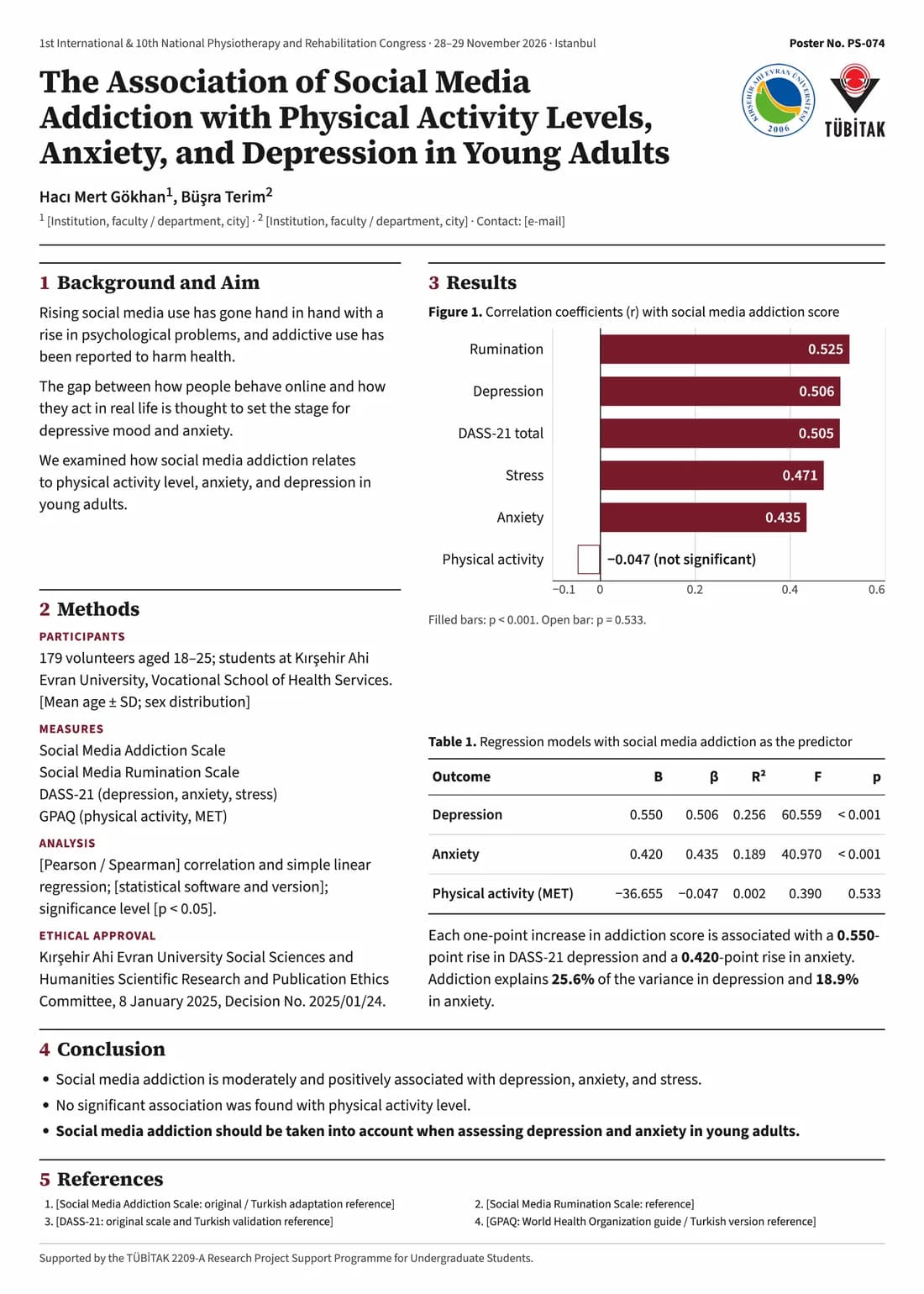
Correlations with the social media addiction score:
- Social media rumination
- r = 0.525p < 0.001
- Depression (DASS-21)
- r = 0.506p < 0.001 · 25.6% of variance
- Stress (DASS-21)
- r = 0.471p < 0.001
- Anxiety (DASS-21)
- r = 0.435p < 0.001 · 18.9% of variance
- Physical activity (GPAQ-MET)
- r = −0.047p = 0.533 · not significant
This is a cross-sectional study: it shows association, not causation.
Conclusion
Social media addiction was moderately and positively associated with depression, anxiety and stress — but not with how physically active young adults were.
Presented as a poster (PS-074) at the 1st International & 10th National Physiotherapy and Rehabilitation Congress, Istanbul, 28–29 November 2026.
Poster